
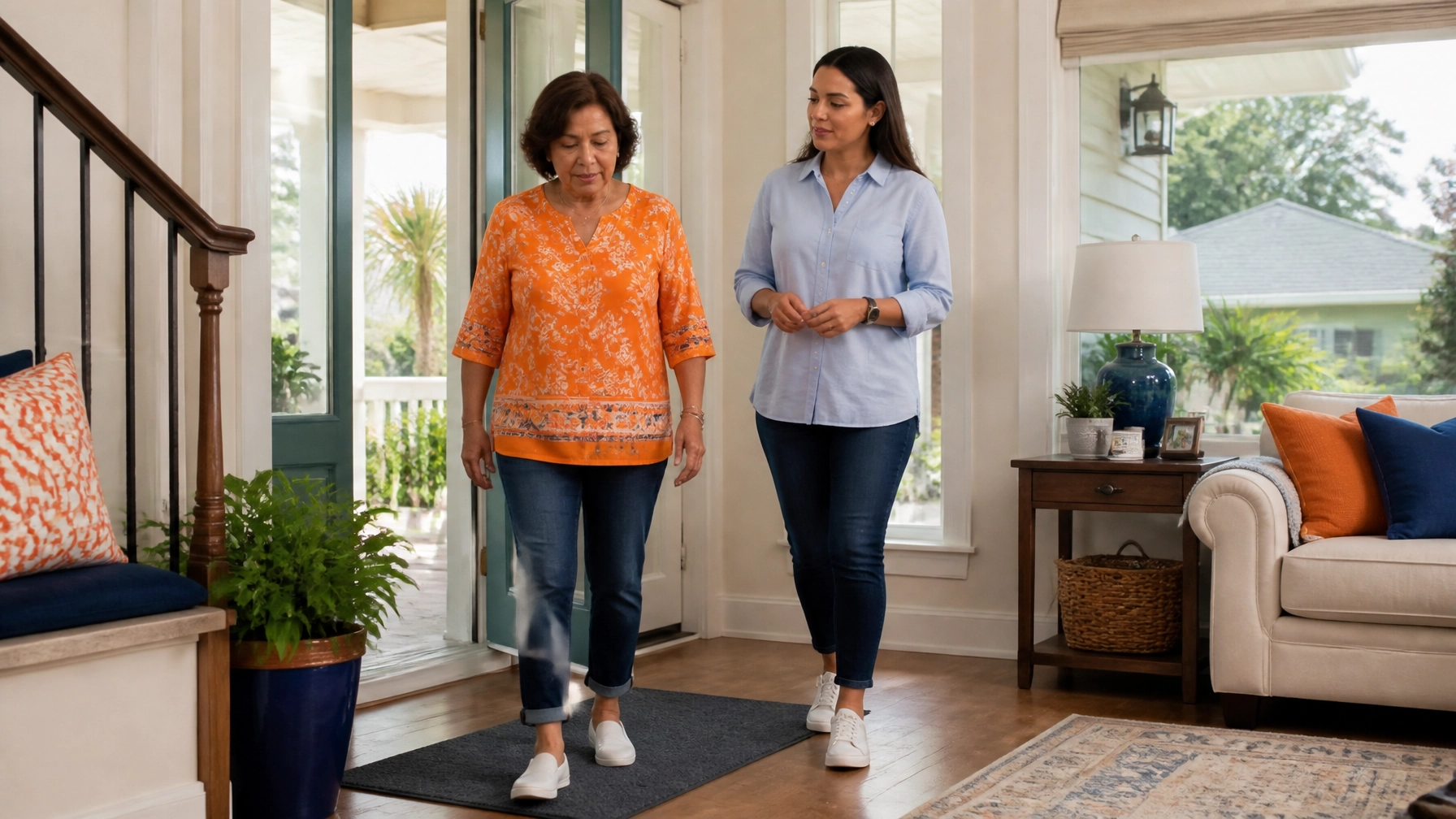
A family member may notice the warning signs gradually: a hand reaching for furniture, a wet tile entryway after a storm, a night trip to the bathroom, or a parent avoiding the stairs. Then the question arrives: What should we change first, and who is responsible for keeping the plan workable?
Fall prevention is not only about removing one rug. It involves the home’s layout, daily routines, lighting, personal assistance, weather planning, and communication among family members and professionals.
The CDC reports that about one in four adults age 65 and older falls each year. A practical home review can help families identify hazards before a close call becomes an injury.
Valiynt Health Group is preparing planned nonmedical Personal Assistance Services. Licensing is pending. Educational inquiries do not constitute intake, referral acceptance, or the beginning of services.
Why fall prevention at home can feel confusing
Families often use “home care,” “home health,” and “help around the house” as if they mean the same thing. They do not.
A Medicare-certified home health agency may provide qualifying skilled services, such as nursing or therapy, when Medicare requirements are met. Nonmedical Personal Assistance Services focus on daily routines such as bathing, dressing, toileting, mobility support, meals, companionship, and household tasks within the provider’s authorized scope.
A family may need both types of support — or neither may be appropriate for an immediate emergency. The first practical question is:
What is the person having difficulty doing, in which room, and at what time of day?
Entryways, porches, and hallways: start where the day begins
Southeast Texas homes may need extra attention after humidity, heavy rain, tropical storms, or power interruptions. Tile and smooth flooring can become slippery when wet. Older homes may also have thresholds, steps, narrow transitions, or lighting arrangements that deserve a closer look.
Walk through the usual entrance and check:
- Are mats secured and lying flat?
- Is water being tracked onto tile or smooth flooring?
- Can the person see the threshold clearly?
- Is there a reliable light switch near the entrance?
- Are shoes, packages, cords, or mail narrowing the walking path?
- Is there a sturdy handhold where a person naturally pauses?
The CDC STEADI Check for Safety checklist recommends clearing walking paths, securing or removing loose rugs, managing cords, improving lighting, and correcting stair hazards.
During heat, storms, or outages, add a simple contingency question: If the power goes out or the normal entrance becomes unsafe, which route will the person use, and who will check it?
Living room and common areas: protect the walking path
The living room often becomes a place where furniture, footstools, phone chargers, pet items, and temporary storage collect. A path that looks manageable during the day may be difficult at night or when someone is tired.
Keep the route between the person’s favorite chair, bathroom, bedroom, and kitchen as direct as possible. Move low tables and baskets out of walking paths. Secure cords against the wall. Remove or firmly secure throw rugs.
Do not assume that a person who has always navigated the room safely will continue to do so after illness, vision changes, weakness, or a change in mobility. Ask:
Which route does the person use most, and what could interrupt it when the room is dim, wet, or crowded?
Kitchen: reduce reaching, climbing, and rushing
In the kitchen, fall prevention often depends on where ordinary items are stored. The CDC checklist recommends keeping frequently used items within easier reach and avoiding chairs as makeshift step stools.
Consider moving everyday dishes, cups, cookware, and food items to shelves that do not require climbing or deep bending. Keep spills cleaned up promptly. Make sure the floor remains clear around the refrigerator, sink, and most-used counter.
A meal plan can also reduce unsafe rushing. If standing for long periods is difficult, identify which meals can be prepared while seated and which tasks require another person.
The useful family question is:
Which kitchen task leads to reaching, climbing, carrying, or hurrying — and can the setup or schedule be changed?
Bathroom: plan for wet surfaces and transfers
Bathrooms combine several fall risks: water, smooth surfaces, turning, reaching, and moving between sitting and standing.
The CDC and National Institute on Aging recommend practical safety measures such as:
- Nonslip surfaces or adhesive strips in the tub or shower
- Secure bath mats outside wet areas
- Grab bars installed in appropriate locations
- Adequate lighting, including a clear path to the bathroom at night
- Frequently used items placed within safe reach
A grab bar should be properly installed and suitable for the intended use. A loose towel bar is not a substitute for a support device.
If bathing, toileting, or transferring has become unsafe, do not solve the problem by simply telling the person to “be more careful.” Identify whether the person needs a home modification, a clinical assessment, hands-on nonmedical assistance, or a different plan altogether.
Bedroom and nighttime routes: make the first steps visible
Many falls happen during transitions: getting out of bed, turning, reaching for clothing, or walking to the bathroom in low light.
Place a lamp within easy reach of the bed. Consider nightlights or automatic lighting along the route. Keep shoes, clothing, phone chargers, and other objects out of the walking path.
Review the bed height and nearby furniture. The goal is not to impose a single setup but to make sitting, standing, turning, and walking more predictable.
Ask:
What happens during the first five minutes after the person wakes up, and who covers that time if help is needed?
Stairs and outdoor areas: inspect the route, not just the steps
Stairs should be free of objects, well lit, and equipped with secure handrails. The CDC checklist recommends handrails on both sides when possible, attached securely and extending along the stairway.
Outside, check steps, walkways, porch surfaces, and transitions to driveways. After storms, look for standing water, debris, poor visibility, or changes caused by temporary equipment and extension cords. During extreme heat, dizziness or weakness can make an ordinary trip more difficult, so errands and outdoor tasks may need to be moved to a safer time.
If there is an immediate safety threat, serious injury, or a medical emergency, call 9-1-1 (nine-one-one).
Texas Personal Assistance Services and Medicare-certified home health are different
This distinction helps families decide what question to ask next.
| Comparison point | Texas Personal Assistance Services | Medicare-certified home health |
|---|---|---|
| Primary purpose | Routine nonmedical support that helps with daily living or independent-living functions, including respite, under applicable Texas rules | Qualifying health services for an eligible person under Medicare’s home health benefit |
| Examples | Personal routines, mobility-related assistance, meals, homemaker support, companionship, and caregiver respite when within the provider’s authorized scope | Skilled nursing, physical therapy, occupational therapy, speech-language pathology, medical social services, and certain home health aide care |
| Clinical role | Does not replace skilled nursing, therapy, diagnosis, or emergency care | Delivered through a Medicare-certified home health agency under a clinical plan of care |
| Schedule | Built around authorized tasks, family coverage, provider scope, staffing, and availability | Generally part-time or intermittent rather than continuous custodial coverage |
| Payment question | Ask which private-pay, insurance, VA, Medicaid, or other pathway may apply and whether the provider participates | Confirm Medicare eligibility, covered services, provider certification, and plan requirements |
| Key family action | Write down the exact routines and hours that need support | Ask the ordering provider or certified agency what is covered and what remains the family’s responsibility |
Medicare states that it does not pay for 24-hour home care, unrelated homemaker services, or custodial or personal care when that is the only care needed. Review the Medicare home health coverage page before assuming that “home health” covers ongoing daily assistance.
Situation examples: what responsibility remains unresolved?
After a hospital stay: Medicare home health may address qualifying clinical needs, but the family may still need to organize meals, bathing, transportation, laundry, and overnight coverage.
When a spouse is exhausted: A safer plan may require scheduled respite, not an informal promise that someone will “stop by if needed.”
When relatives live elsewhere: The unresolved task may be coordination: who checks the home after a storm, confirms groceries are available, and knows the backup plan?
When the person refuses help: Start with one specific routine, such as getting safely into the shower or preparing breakfast, rather than presenting “home care” as a loss of independence.
Practical payment planning
Begin by separating the service from the payment source. First identify the task, schedule, and type of provider required. Then ask which payment pathway might apply.
Families may investigate:
- Private payment and household budgeting
- Long-term-care insurance reimbursement
- VA-related benefits for eligible individuals
- Medicaid-related programs and managed-care benefits
- Community resources and caregiver-support programs
Eligibility, authorization, reimbursement, and provider participation must be confirmed directly with the relevant program, policy, plan, or provider. Do not assume that a benefit will pay for every task or that a provider participates in a particular network.
The Area Agency on Aging of Southeast Texas offers caregiver support, care coordination, and benefits counseling resources for eligible older adults and caregivers in the region.
Family responsibility worksheet
Write down the answers before contacting a provider or care coordinator:
- Room or route of concern: ____________________
- Task becoming difficult: ____________________
- Most difficult time of day: ____________________
- What the person can do independently: ____________________
- What a family member currently covers: ____________________
- Uncovered day or hour: ____________________
- Backup person if the usual helper is unavailable: ____________________
- Storm, heat, or power-outage plan: ____________________
- Question for the physician, therapist, or nurse: ____________________
- Possible payment sources to verify: ____________________
For a broader planning tool, use Valiynt’s Complete Home Support Planning Checklist.
Provider checklist
Before comparing options, ask:
- What exact tasks are included?
- Which tasks are outside the provider’s nonmedical scope?
- How are bathing, toileting, transfers, and mobility-related tasks defined?
- What supervision and safety-monitoring language does the provider use?
- What happens when a scheduled worker is unavailable?
- Is there a minimum visit length?
- How are weather disruptions and power outages handled?
- Which payment sources are accepted or under consideration?
- What clinical concerns require another licensed professional?
- How will the family receive updates?
Final next step
Use the room-by-room review with the family member who knows the daily routine best. Choose one route, one task, and one uncovered time period to discuss first. For additional context, compare Valiynt’s planned services, Southeast Texas home-care cost guide, and Medicare coverage explanation.
Save or share this checklist with the people coordinating care, and follow Valiynt Health Group for future Southeast Texas caregiver guidance.