
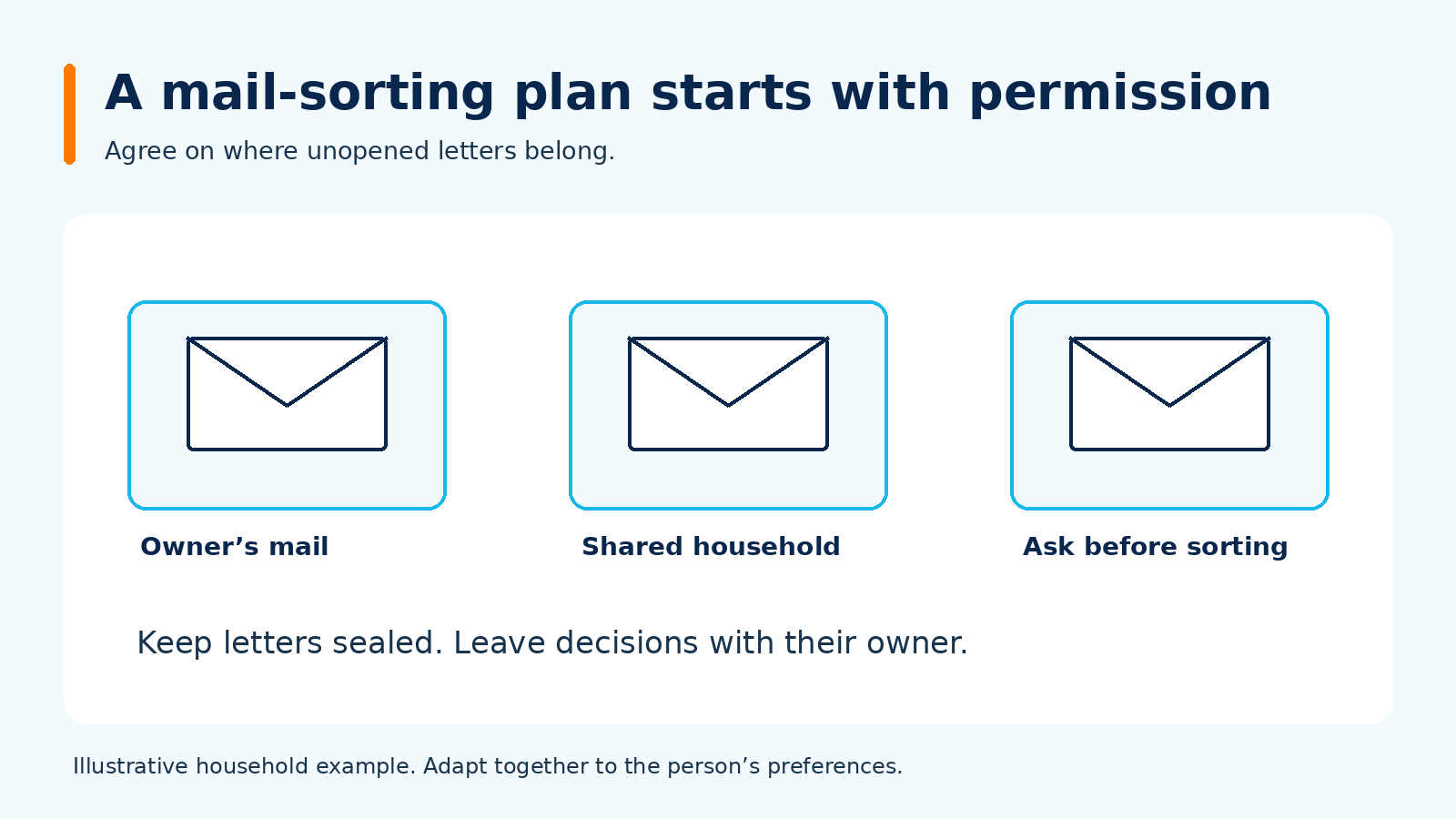
A relative may appreciate someone bringing the mail inside without wanting anyone to read it. Another person may want help separating their letters from the rest of the household's mail. Start with that distinction before buying trays or creating a filing system.
For families in Southeast Texas, an ordinary basket, folder, or cleared corner may be enough. The useful part is agreeing on what happens next. A mail routine should make the person's chosen papers easier to find while leaving decisions about opening, keeping, and sharing with them.
Ask what kind of help is welcome
Use a specific question: “Would you like me to put your unopened mail in one place, or would you prefer to sort it together?” Ask where that place should be and who may use it.
Do not assume permission to collect mail includes permission to open envelopes, photograph contents, or act on anything inside. Keep the first arrangement small. Someone who wants help carrying a stack indoors may still prefer to handle every envelope themselves.
If another household member has a different preference, give that person a separate place. Avoid a shared folder that quietly combines everyone's correspondence.
Choose simple places, not complicated categories
Begin with two destinations: “Unopened mail for you” and “Items you asked me to help with.” The second should contain only papers the person has deliberately handed over for a particular task.
A closed folder may suit someone who does not want visitors seeing envelope fronts. A tray may suit someone who wants everything visible. Let the person choose rather than treating one arrangement as universally better.
Avoid deciding that an envelope is unimportant because it looks like advertising. Leave opening, discarding, and any follow-up decisions to the addressee unless they have specifically asked for help with those steps.
Keep physical mail separate from digital previews
If the person already uses USPS Informed Delivery, understand what its preview represents. USPS says its grayscale letter images show the address side of incoming letter-sized mail. They do not reveal the contents of an envelope. USPS also explains that its service includes package status information. [1]
A preview is not a complete checklist of what must be physically present that day. USPS notes that mail and packages may arrive on a different day from the notification. [1] Record what was actually placed in the agreed folder rather than treating an email preview as proof of receipt.
This paper routine does not require setting up a USPS account or sharing access to an existing one. Keep any account choices with the owner.
Try a short preference card
Here is a fictional example a household could adapt:
- Mail goes: in the blue folder beside the desk.
- Envelopes stay: unopened.
- Papers for shared help: only those handed to the helper.
- Ask before: photographing, moving elsewhere, or discarding anything.
- Check the arrangement again: when the owner wants a change.
Keep the card where the person chooses. It needs no account numbers, sender list, or explanation of private correspondence. The aim is to remember the arrangement, not create another record of someone's affairs.
Review the routine together
After trying it, ask whether the mail is easier to locate and whether the folder is in the right place. If stacks accumulate, ask what would be useful rather than silently adding new categories.
A clear handoff can be as simple as, “Today's unopened mail is in your blue folder.” There is no need to announce senders or describe envelopes to other relatives. Keep the routine easy to change, and let the person decide how much help they want next time.
For a separate project involving household belongings rather than correspondence, see our owner-led donation sorting guide.
Valiynt Health Group is preparing to offer Personal Assistance Services in Texas. Its HCSSA license is pending. Services are not available, and Valiynt is not accepting clients.
References
[1] USPS, Informed Delivery: https://www.usps.com/manage/informed-delivery.htm (opened November 5, 2026; address-side images, package information, and delivery-timing limitation).